Table of Contents
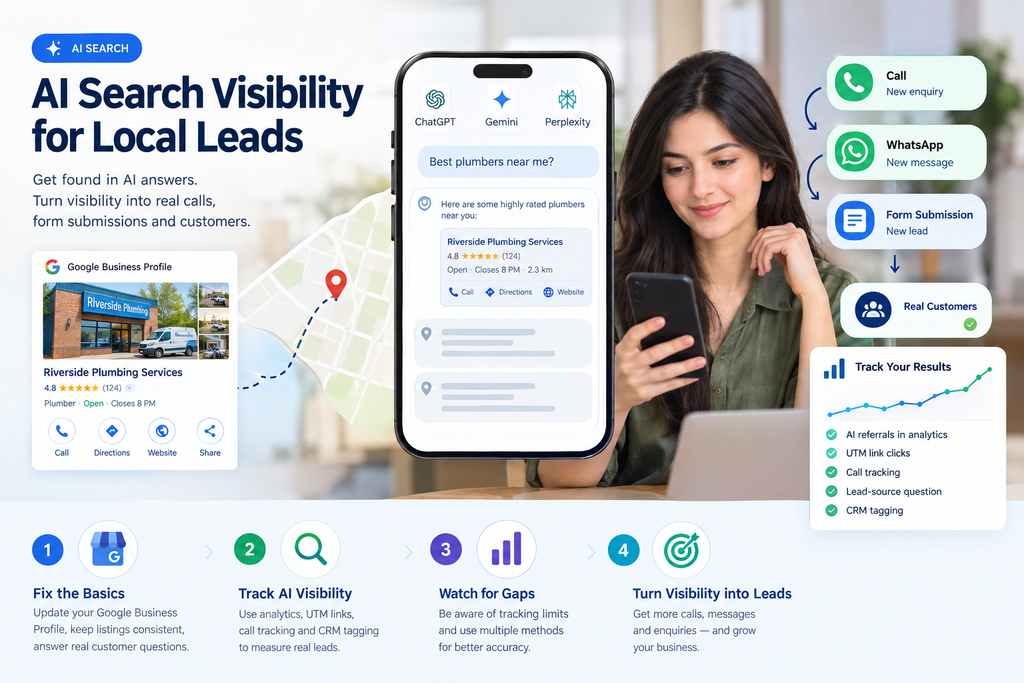
Want more local enquiries from ChatGPT and Google AI? Improving your AI search visibility for local leads is now essential for any local business
People now ask ChatGPT, Gemini, and Google’s AI Overviews where to find a plumber, dentist, or accountant nearby. If your business gets named in those answers, that’s a great start. But most owners skip the next question: did that mention turn into a call?
Getting AI search visibility for local leads is only half the job. The other half is proving it works. In this guide, I’ll show you how to improve AI search visibility for local leads and fix the basics AI tools rely on and how to track AI-driven enquiries step by step. I’ll also cover where tracking still falls short.
What AI Search Visibility for Local Leads Means for a Local Business
AI search visibility for local leads is how often your business appears, gets cited, or gets recommended inside AI-generated answers. That includes ChatGPT, Gemini, Perplexity, and Google AI Overviews.
Visibility alone doesn’t pay the bills, though. A lead does. That could be a phone call, a form submission, a WhatsApp message, or a booking. So the real chain looks like this:
AI mention → website visit or call → enquiry → customer
Most businesses can’t see where that chain breaks. That’s the gap we’re fixing Most businesses can’t see where that chain breaks. That’s the gap we’re fixing with proper AI search visibility for local leads tracking.
Why Local AI Search Visibility Deserves Your Attention
Google says AI Overviews and AI Mode may run several related searches behind the scenes before building one answer. So a single customer question can pull from many pages and sources. The more consistent and trustworthy your business information is, the easier it is for these systems to understand you. google
Here’s the reassuring part. Google’s own guidance says standard SEO best practices still apply to its AI features. You don’t need a secret playbook. You need solid local SEO and a way to measure the results. google
Step 1: Fix the Basics AI Tools Rely On
My own work centers on Google Business Profile optimization, local SEO, reviews, and website content. The most common mistake I see is inconsistent or incomplete business information across a website and its online profiles. Add a neglected Google Business Profile, few reviews, and thin service pages, and it gets hard for search engines and AI tools to trust the business.https://en.wikipedia.org/wiki/AI_Futures_Project
On one client project, I updated the Google Business Profile with accurate services, photos, and business details. I also improved the local SEO content and helped the business collect more genuine reviews. Visibility for relevant local searches improved, and the business received more calls and local enquiries.
That wasn’t AI-specific work. Still, I treat it as the foundation for AI search visibility, because clear, consistent information helps everywhere.
Complete Your Google Business Profile
Start with these details:
- Accurate services
- Correct location
- Current opening hours
- Fresh photos
- Working phone number, website, and other contact details
Keep Your Listings Consistent
Your business name, address, phone number, hours, and services should match on your website and other trusted local listings. Small differences, like an old phone number, create doubt.
Answer Real Customer Questions
Add clear, useful content about your services and location. Think about what customers ask before they call, then answer those questions on your service pages. This gives search engines and AI tools reliable information to recommend.
Step 2: Track AI Search Visibility to Real Leads
Once the basics are solid, set up tracking. Here is the four-step process I’d use.
- Capture the source. Check your analytics referral data for AI tools, such as chatgpt.com, perplexity.ai, or gemini.google.com. Add UTM parameters to links you control, like the website link on your profiles. Some AI tools tag their links and others don’t, so never rely on this alone.
- Watch visitor actions. Set up conversion events for form submissions, call clicks, and WhatsApp enquiries.
- Confirm with real people. Use call tracking and a simple lead-source question: “How did you hear about us?” Add “AI tool (ChatGPT, Gemini, etc.)” as an option.
- Record it in your CRM. Tag each lead with its source and connect it to the original AI source. Then review conversions every month.
Here’s how the methods compare:
| Method | What it shows | Main limitation |
| Referral data in analytics | Visits from AI tools | Some visits show up as direct traffic |
| UTM parameters | Clicks on links you control | Only works where you place the link |
| Call tracking | Which source drove a call | Needs setup and can’t show the AI prompt |
| Lead-source question | The customer’s own words | Depends on memory and honesty |
| CRM tagging | Lead-to-customer conversion | Only as good as the data entered |
The Honest Part: What Tracking Can’t Prove Yet
I haven’t personally tracked a confirmed lead or call from ChatGPT or Google AI Overviews yet, and I won’t pretend otherwise. That’s exactly why I’d rely on evidence, not assumptions, when measuring AI search visibility.
Keep these limits in mind:
- AI referrals often land in “direct” traffic.
- Someone may see your name in an AI answer, then Google your brand later. That lead then looks like branded search.
- Results vary by tool, location, and question.
So treat your numbers as directional. Combine analytics with the lead-source question, and watch trends over several months.
One Thing to Do This Week
If you only have time for one task, fully update your Google Business Profile. Then make sure your website and top local listings match it. Finally, add one page that answers common customer questions about your services and location.
It’s simple work, and it gives AI tools reliable information to improve your AI search visibility.
FAQs
What is AI search visibility for local businesses?
It’s how often AI tools mention or recommend your business when people ask local questions, such as “best electrician near me.”
Can I track leads from ChatGPT or Google AI Overviews?
Partly. Referral data, UTM links, call tracking, and lead-source questions all help. No single method is perfect, so use several together.
Do I need a different SEO strategy for AI search?
Not entirely. Google says standard SEO best practices still apply to its AI features. Focus on accurate business information, genuine reviews, and helpful local content.
How long does it take to see results?
There’s no fixed timeline. In my local SEO client work, improvements showed within a few months. AI results vary, so I can’t promise the same pace.
Conclusion:AI Search Visibility for Local Leads
AI Search Visibility for Local Leads isn’t magic. It starts with accurate, consistent business information to improve your AI Search Visibility for Local Leads. It grows with genuine reviews and helpful local content. And it only becomes valuable when you track it to real enquiries and improve your AI Search Visibility for Local Leads strategy.
Your next steps:
- Update your Google Business Profile.
- Make your website and listings consistent.
- Set up conversion tracking and a lead-source question
- .Tag every lead in your CRM.
Start with step one this week. Then measure, learn, and adjust for AI search visibility for local leads. Learn more at https://adithyac.com/